How to Apply for Free Legal Aid in Delhi (Step-by-Step Guide)
If you’re facing a legal issue in Delhi and can’t afford a lawyer, you don’t have to handle it alone — and you don’t need to fully understand the law to get help. The Delhi State Legal Services Authority (DSLSA) exists to provide exactly that kind of support, and the process to apply is more straightforward than most people expect. Here’s exactly how it works.
Quick Answer: How Do I Apply for Free Legal Aid in Delhi?
Visit the DSLSA front office at your district court complex, or submit a written application explaining your matter, along with proof of income or eligibility category. A Scrutiny and Evaluation Committee reviews the application, and if approved, a legal aid advocate is assigned to you at no cost. You can also call DSLSA’s 24×7 helpline at 1516 for immediate guidance.
Who Provides Free Legal Aid in Delhi?
Free legal aid in Delhi is delivered through a few connected channels. The Delhi State Legal Services Authority (DSLSA) is the state-level body, working under the administrative control of the Delhi High Court, with its central office at the Rouse Avenue District Court Complex. Below that sit the District Legal Services Authorities (DLSA), one for each district court in Delhi, which handle most individual applications directly. Alongside these, DSLSA also runs Legal Aid Clinics at the community level, so help isn’t limited to court premises alone.
Are You Eligible? Delhi's Income Limits and Categories
Delhi-Specific Income Limits
Delhi sets its own income thresholds under the Delhi Legal Services Authority Regulations, 2002, and they’re worth knowing because they differ from the general figures often quoted for other states:
Applicant category | Annual income limit |
General applicant | Below ₹3 lakh |
Senior citizen | Below ₹4 lakh |
Transgender person | Below ₹4 lakh |
Categories Eligible Regardless of Income
Income isn’t the only route to eligibility. Women, in Delhi, are eligible for free legal aid regardless of their income. So are members of a Scheduled Caste or Scheduled Tribe, persons with disabilities, industrial workmen, victims of trafficking or mass disaster, and persons in custody — including in protective homes, juvenile homes, or psychiatric institutions. These categories reflect the broader eligibility rules under Section 12 of the Legal Services Authorities Act, 1987, applied at the Delhi level.
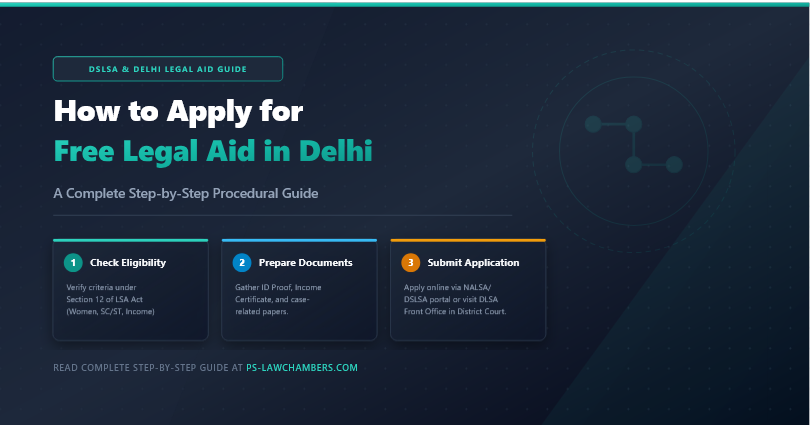
Your 5-Step Application Process
Step 1 — Identify Your District
Delhi’s legal aid system is organised by district, so start by confirming which district your matter falls under — this is usually based on where the incident occurred or where the case is being heard. If you’re unsure, DSLSA’s helpline can point you in the right direction rather than you having to guess.
Step 2 — Visit the DLSA Front Office or Apply in Writing
Every DLSA in Delhi has a front office on the ground floor of its court complex, staffed by paralegal volunteers who can guide you on the spot. You can also apply in writing, briefly explaining your matter and why you’re seeking legal aid, using either a plain application or the prescribed form. If you’re unable to write, an officer at the Authority will record your submission verbally and take your thumb impression or signature instead this is a built-in accommodation, not an obstacle.
Step 3 — Submit Your Documents
You’ll generally need proof of identity, along with documents supporting your eligibility; an income proof or self-declared income affidavit if applying on that basis, or a relevant certificate (such as a caste or disability certificate) if applying under one of the specific categories above.
Step 4 — Application Review by the Scrutiny and Evaluation Committee
Your application is reviewed by a Scrutiny and Evaluation Committee, which checks both eligibility and whether the matter has genuine legal merit, in line with Regulation 7 of the NALSA (Free and Competent Legal Services) Regulations, 2010. This step exists to make sure aid goes to genuine cases, it isn’t a judgment on whether you’ll win, just a basic check that there’s a real legal matter to pursue.
Step 5 — Get Your Legal Aid Advocate Assigned
Once approved, you’re assigned an empanelled legal aid advocate at no cost to you. DSLSA covers the court fee, process fee, and typing fee as well; the entire cost of the case is borne by the government, not by you.
What If Your Application Is Rejected?
A rejection isn’t necessarily the end of the road. If your application for legal aid is denied, you can appeal to the Chairman of the concerned Authority or Committee. If that appeal is also unsuccessful, a further appeal lies before the Executive Chairman of DSLSA, whose decision is final. Similarly, if you’re unhappy with the conduct of the advocate assigned to you, you’re entitled to raise that complaint with your concerned DLSA.
Need Help Right Now? Delhi's 24×7 Legal Aid Helpline
If you need guidance immediately, rather than waiting to visit an office in person, DSLSA runs a toll-free helpline 1516, that operates 24 hours a day. It’s a reasonable first call if you’re not sure whether your situation qualifies, or which district office to approach.
Common Mistakes to Avoid
- l Assuming you don’t qualify because of your income several categories, including women, qualify regardless of income in Delhi.
- l Going to the wrong district office, which slows things down unnecessarily confirm jurisdiction first, or call the helpline.
- l Submitting an incomplete application without supporting documents for the eligibility category being claimed.
- l Assuming a rejected application is final the appeal route exists precisely for this situation.
Frequently Asked Questions
Yes. If your application is approved, you don’t pay the advocate, and DSLSA covers court fees, process fees, and typing fees as well.
Yes. You can walk into any DLSA front office and get guidance directly from paralegal volunteers, or apply in writing yourself.
Yes. Women are eligible for free legal aid in Delhi irrespective of their income or financial status.
DSLSA runs a 24×7 toll-free helpline at 1516 for legal aid guidance.
There’s no single fixed timeline, it depends on the completeness of your application and the workload of the Scrutiny and Evaluation Committee. Having your documents ready in advance generally helps move things faster.
You can appeal to the Chairman of the concerned Authority or Committee, and if needed, further to the Executive Chairman of DSLSA, whose decision is final.
Key Takeaways
- Delhi has its own income limits for legal aid eligibility; below ₹3 lakh generally, ₹4 lakh for senior citizens and transgender persons.
- Women and several other categories qualify regardless of income.
- Applications can be made in person at a DLSA front office or in writing, and go through a Scrutiny and Evaluation Committee before an advocate is assigned.
- The entire process is free to the applicant.
- A rejected application can be appealed; DSLSA’s 24×7 helpline (1516) is available for immediate guidance.
Applying for free legal aid in Delhi is a defined, accessible process not something you need a lawyer just to start. This article explains the general process based on DSLSA’s own published procedures; it is legal information, not legal advice, and doesn’t address the specific facts of any individual case. Procedures and income limits can also change over time, so it’s worth confirming current details directly with DSLSA before you apply. For a broader look at how the right to free legal aid works across India, see our companion guide, What Is Free Legal Aid in India?