What Is Free Legal Aid in India? A Complete Guide
Not everyone who needs a lawyer can afford one. India’s Constitution and its legal aid framework were built around that simple fact – the idea that access to justice should not depend on a person’s income. This guide explains what free legal aid actually is, who qualifies for it, and how the process works in practice, specially at the level of the Supreme Court of India.
Quick Answer: What Is Free Legal Aid?
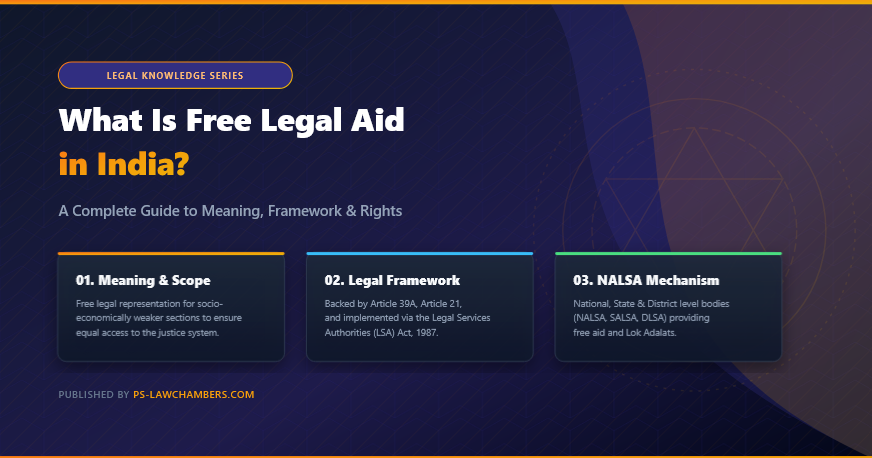
Free legal aid is legal representation and advice provided at no cost to persons who cannot afford it or who belong to specific categories recognised by law – including women, children, members of Scheduled Castes and Scheduled Tribes, persons with disabilities, and those in custody. It is available at every level of the Indian judicial system, from trial courts to the Supreme Court of India, and is administered through the National Legal Services Authority (NALSA) and its state and district counterparts.
What Does the Constitution Say About Free Legal Aid?
Article 39A - Equal Justice and Free Legal Aid
Article 39A was inserted into the Constitution by the 42nd Amendment in 1976, as one of the Directive Principles of State Policy. It directs the State to secure a legal system that promotes justice on the basis of equal opportunity, and specifically to provide free legal aid so that no citizen is denied the opportunity to secure justice because of economic or other disadvantage.
Article 21 - Free Legal Aid as Part of the Right to Life
Directive Principles are not directly enforceable in court on their own, but the Supreme Court has repeatedly read Article 39A together with Article 21’s guarantee of the right to life and personal liberty. In Hussainara Khatoon (4) v. State of Bihar, (1980) 1 SCC 98, the Supreme Court held that a procedure which does not make legal assistance available to an accused person too poor to afford a lawyer cannot be considered “reasonable, fair and just” under Article 21. In M.H. Hoskot v. State of Maharashtra ((1978) 3 SCC 544), the Supreme Court went further, holding that the right to free legal aid extends to the appellate stage as well, not just the trial. Together, these judgments established that free legal aid is not merely a welfare scheme – it is, in substance, a constitutional right for those who cannot otherwise access it.
The Legal Services Authorities Act, 1987
To give practical effect to Article 39A, Parliament enacted the Legal Services Authorities Act, 1987, which came into force on 9 November 1995. The Act created a structured system for delivering legal aid across the country rather than leaving it to ad hoc arrangements.
National, State & District Legal Services Authorities (NALSA / SLSA / DLSA)
The Act set up a three-tier structure: the National Legal Services Authority (NALSA) at the apex, which frames policy and monitors implementation nationwide; a State Legal Services Authority (SLSA) in each state; and District Legal Services Authorities (DLSA) and Taluk Legal Services Committees, which handle applications and deliver services at the grassroots level. A separate Supreme Court Legal Services Committee handles applications relating to matters before the Supreme Court itself.
What the Act Provides For
Under Section 2(c) of the Act, “legal services” includes both representation in court proceedings and legal advice on any legal matter. Section 13(1) makes entitlement conditional on the relevant Legal Services Authority being satisfied that the applicant has a genuine case to pursue or defend – free legal aid is not automatic simply because someone applies; it depends on both eligibility and the merits of the matter.
Who Is Eligible for Free Legal Aid in India?
Section 12 of the Act lists the categories of persons entitled to free legal services. Eligibility is based on a mix of social vulnerability and, separately, income – not income alone.
Categories of Persons Entitled Under Section 12
- Members of a Scheduled Caste or Scheduled Tribe
- Victims of trafficking in human beings or of begar (forced labour), as referred to in Article 23 of the Constitution
- Women and children
- Persons with a disability, as defined under applicable disability legislation
- Persons in circumstances of undeserved want – including victims of a mass disaster, ethnic violence, caste atrocity, flood, drought, earthquake, or industrial disaster
- Industrial workmen
- Persons in custody, including those in protective homes, juvenile homes, or psychiatric institutions
- Persons whose annual income falls below the limit prescribed for their state (a higher limit applies to matters before the Supreme Court)
Income-Based Eligibility Criteria
Income ceilings under Section 12(h) are set and periodically revised by the respective State Governments (and, for Supreme Court matters, by the Central Government), so the exact figure differs from state to state and changes over time. If your eligibility depends on income rather than one of the categories above, it’s worth confirming the current limit with your District Legal Services Authority or NALSA directly rather than relying on a figure that may be outdated by the time you read this.
What Kind of Legal Matters Are Covered?
Civil Matters
Legal aid counsel can represent eligible persons in civil disputes, including matters relating to property, family, and consumer protection, among others.
Criminal Matters
In criminal proceedings, legal aid is especially significant for accused persons who cannot afford a lawyer, including at the stage of remand and bail – an area the Supreme Court addressed directly in Sheela Barse v. Union of India (1986 AIR 1773), which held that legal representation for a person in custody who risks losing their liberty is a constitutional obligation.
How to Apply for Free Legal Aid in India
Step 1 - Identify the Relevant Legal Services Authority
Applications are made to the District Legal Services Authority (DLSA) for matters before subordinate courts, the State Legal Services Authority for High Court matters, or the Supreme Court Legal Services Committee for matters before the Supreme Court. In Delhi, applications for district-level matters go through the Delhi State Legal Services Authority (DSLSA), which maintains front offices at each district court complex.
Step 2 - Prepare the Required Documents
This typically includes proof of identity, a self-declared affidavit of income (which the authority may accept unless there is reason to doubt it), and any documents relevant to the category of eligibility being claimed – for example, a caste certificate or disability certificate, where applicable.
Step 3 - Submit the Application
Applications can generally be submitted in person at the relevant Legal Services Authority office, or in many states, online through the NALSA or state legal services portal.
Step 4 - Assignment of a Legal Aid Counsel
Once the authority is satisfied that the applicant is eligible and has a genuine case, a legal aid counsel is assigned from the panel of empanelled advocates to represent them through the proceedings.
Free Legal Aid vs. Pro Bono Legal Services: What's the Difference?
The two are often used interchangeably, but they work differently:
Free Legal Aid | Pro Bono Legal Services | |
What it is | A statutory entitlement under the Legal Services Authorities Act, 1987 | Voluntary, unpaid legal work an advocate chooses to take on |
Who administers it | NALSA, SLSA, DLSA, or the Supreme Court Legal Services Committee | Individual advocates or law firms, at their own discretion |
Eligibility | Governed by fixed criteria under Section 12 of the Act | No fixed statutory criteria – decided case by case |
How it’s accessed | Formal application to the relevant Legal Services Authority | Direct request to an advocate or referral through a legal aid clinic/NGO |
Common Mistakes People Make When Seeking Free Legal Aid
Applying to the wrong authority – for example, approaching a DLSA for a matter that is actually pending before the Supreme Court, which delays the process unnecessarily.
- Submitting an incomplete or unclear income affidavit, which can slow down the eligibility assessment.
- Assuming legal aid guarantees a favourable outcome – it guarantees representation and advice, not a particular result; the merits of every case still depend on its own facts.
- Confusing a free initial consultation offered by a private advocate with statutory legal aid – the two are not the same thing, as the comparison above shows.
Frequently Asked Questions
Yes. Once an application is accepted, the assigned advocate’s fees and associated legal representation are provided at no cost to the eligible applicant.
Eligibility is set out in Section 12 of the Legal Services Authorities Act, 1987, and covers specific categories – including women, children, SC/ST members, persons with disabilities, industrial workmen, and persons in custody – as well as anyone whose income falls below the state-prescribed limit.
Yes. The Supreme Court Legal Services Committee handles applications for free legal aid in matters pending before the Supreme Court of India, subject to the same eligibility and merit requirements.
Generally, proof of identity, an income affidavit, and any category-specific document (such as a caste or disability certificate) supporting the eligibility claimed.
Not quite. Legal aid counsel are typically private advocates empanelled with the Legal Services Authority, rather than government employees, though they are paid by the Authority for the work done.
Legal Authorities do work with NGOs and legal aid clinics that assist eligible persons in preparing and submitting applications, though the application itself is made in relation to the eligible individual’s case.
Legal advice is guidance on a legal question or situation; legal aid is broader and can include full representation in court proceedings, in addition to advice – both fall within “legal services” as defined under the Act.
Timelines vary by authority and case load, and by the urgency of the matter (for instance, custody-related applications are generally handled faster). There is no single fixed statutory timeline, so it’s reasonable to follow up directly with the relevant office.
Key Takeaways
- Free legal aid in India is rooted in Article 39A of the Constitution and has been read by the Supreme Court as part of the right to life under Article 21.
- It is administered under the Legal Services Authorities Act, 1987, through NALSA, SLSA, DLSA, and the Supreme Court Legal Services Committee.
- Eligibility depends on specific categories set out in Section 12 of the Act, or on income, and also requires the case to have genuine merit.
- Legal aid is available at every level of the judicial system, including before the Supreme Court of India.
- Free legal aid is a statutory entitlement, distinct from voluntary pro bono work by individual advocates.
This article is intended to help readers understand what free legal aid is and how the system works in general – it is legal information, not legal advice, and is not a substitute for guidance on the specific facts of an individual case. Eligibility criteria, income limits, and procedures can also change over time, so it’s worth confirming current requirements with NALSA, your State/District Legal Services Authority, or the Supreme Court Legal Services Committee directly.