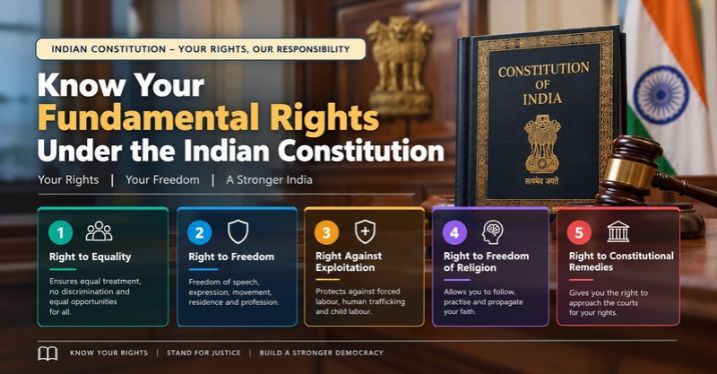
Know Your Fundamental Rights Under the Indian Constitution
Fundamental rights in India are the basic rights that Part III (Articles 12 to 35) of the Constitution gives to every person. There are six groups of these rights. If the State takes away your right, you can ask the court to protect it.
Many people learn about these rights only when a problem comes, such as a police stop or a job dispute. This guide explains them in simple words, so you know what you can ask for and where to go.
At a Glance
- Where: Part III of the Constitution, Articles 12 to 35
- How many: 6 groups of rights
- Who can use them: some are for every person, some only for citizens
- Against whom: mainly the State (government and its authorities)
- Where to go: Supreme Court (Article 32) or High Court (Article 226)
- Limits: not absolute; the State can put reasonable limits
What Are Fundamental Rights in India?
Meaning of Fundamental Rights
Fundamental rights are the most basic rights of a person living in India. They are written in Part III of the Constitution, from Article 12 to Article 35. They protect your freedom, your dignity and your right to equal treatment.
Why They Are Called “Fundamental”
They have two special features. First, they are written in the Constitution. Under Article 13, a law that goes against a fundamental right is void to that extent. Second, courts can enforce them. If your right is violated, you can go to the Supreme Court or a High Court.
Fundamental Rights vs Ordinary Legal Rights
An ordinary legal right comes from a normal law, and Parliament can change it by passing a new law. A fundamental right comes from the Constitution and has stronger protection. The right to property is a good example. It was once a fundamental right, but the 44th Amendment in 1978 removed it from Part III. Today it is a legal right under Article 300A.
The 6 Fundamental Rights at a Glance
Here is a quick table.
| Right | Articles | What it protects | Everyday example |
|---|---|---|---|
| Right to Equality | 14-18 | Equal treatment, no discrimination, equal chance in government jobs, end of untouchability | No one can stop you from using a public well or entering a shop because of your caste |
| Right to Freedom | 19-22 | Speech, movement, work, protection in criminal cases, life and liberty, education, arrest safeguards | The police must tell you why you are arrested |
| Right against Exploitation | 23-24 | No trafficking, forced labour or child labour | A child under 14 cannot be made to work in a factory or mine |
| Right to Freedom of Religion | 25-28 | Freedom to follow and practise your religion | You can pray in your own way |
| Cultural and Educational Rights | 29-30 | Protection of language, script and culture; minority schools | A linguistic minority can run its own school |
| Right to Constitutional Remedies | 32 | Right to go to the Supreme Court for your rights | You can file a petition if your right is violated |
Right to Equality (Articles 14-18)
Article 14 says everyone is equal before the law and has equal protection of the laws. Article 15 stops the State from discriminating on grounds of religion, race, caste, sex or place of birth. Article 16 gives equal opportunity in government jobs. Article 17 abolishes untouchability. Article 18 abolishes titles given by the State, except military and academic honours.
Right to Freedom (Articles 19-22)
Article 19 gives citizens six freedoms: to speak and express, to meet peacefully without arms, to form associations or unions, to move freely across India, to live in any part of India, and to do any job, trade or business.
Article 20 protects people accused of a crime. No one can be punished for an act that was not a crime when it was done, punished twice for the same offence, or forced to give evidence against himself. Article 21 protects life and personal liberty. Article 21A gives free and compulsory education to children aged 6 to 14. Article 22 gives safeguards on arrest, such as the right to know the reason and to consult a lawyer.
Right against Exploitation (Articles 23-24)
Article 23 bans human trafficking, begar (forced work without pay) and other forced labour. Article 24 says no child below 14 years can be employed in a factory, mine or other dangerous work.
Right to Freedom of Religion (Articles 25-28)
Article 25 gives every person freedom of conscience and the right to follow, practise and spread religion, subject to public order, morality and health. Article 26 lets religious groups manage their own religious affairs. Article 27 says no one can be forced to pay tax to promote a religion. Article 28 limits religious teaching in institutions fully run on State funds.
Cultural and Educational Rights (Articles 29-30)
Article 29 lets any group of citizens with its own language, script or culture protect it. Article 30 gives religious and linguistic minorities the right to set up and run educational institutions of their choice.
Right to Constitutional Remedies (Article 32)
This right makes the other rights real. Article 32 lets you go straight to the Supreme Court if a fundamental right is violated. Dr B.R. Ambedkar described it as the very heart and soul of the Constitution.
Who Can Claim Fundamental Rights?
Some rights are for every person in India, including foreigners. Others are only for citizens.
Rights Available to Every Person
- Article 14: equality before the law
- Articles 20 and 21: protection in criminal cases, and life and personal liberty
- Article 21A: education for children aged 6 to 14
- Article 22: safeguards on arrest and detention
- Articles 23 and 24: no forced labour or child labour
- Articles 25 to 28: freedom of religion
One exception to note: under Article 22(3), the arrest safeguards in Article 22(1) and 22(2) do not apply to an enemy alien or to a person held under a preventive detention law.
Rights Available Only to Citizens
Article 15 (no discrimination by the State), Article 16 (equal opportunity in public jobs), Article 19 (six freedoms) and Article 29 (protection of language, script and culture) are for citizens only.
Limits on Fundamental Rights
Reasonable Restrictions
Fundamental rights are not unlimited. The State can put reasonable limits, for example for the security of the State, public order, decency or morality. The limit must be reasonable, and courts can check it. For example, you can protest peacefully, but not with violence.
What Happens During an Emergency?
During a National Emergency, the President can suspend the right to move court for some fundamental rights (Article 359). Since the 44th Amendment in 1978, this cannot be done for Articles 20 and 21. So protection against wrongful punishment and the right to life and liberty remain.
Can Parliament Take Them Away?
Parliament can amend the Constitution, but in Kesavananda Bharati (1973) the Supreme Court held that it cannot change the “basic structure”.
Courts have also read many rights into Article 21, such as privacy and the right to live with dignity.
How to Enforce Your Fundamental Rights
Article 32 vs Article 226
Under Article 32, you can go directly to the Supreme Court. Under Article 226, you can go to the High Court. A High Court can issue writs not only for fundamental rights but also for “any other purpose”, so its power is wider.
The Five Writs in Simple Words
- Habeas corpus: asks the court to check if a person’s detention is legal
- Mandamus: orders a public authority to do its legal duty
- Prohibition: stops a lower court or tribunal from going beyond its power
- Certiorari: cancels a wrong order of a lower court or authority
- Quo warranto: asks a person to show by what right he holds a public office
Fundamental Rights, Directive Principles and Duties
Part IV of the Constitution lists Directive Principles. These are goals for the State, and courts do not enforce them directly. Article 51A lists the Fundamental Duties of citizens, added in 1976. Rights and duties go together: you can ask for fair treatment, and you should respect the law and others’ rights.
Official Resources
- Constitution of India: indiacode.nic.in
- Supreme Court of India: sci.gov.in
- National Legal Services Authority (NALSA): nalsa.gov.in
- Delhi State Legal Services Authority (DSLSA): dslsa.org
- National Human Rights Commission (NHRC): nhrc.nic.in
Fundamental Rights in India: Common Questions
1. What are the fundamental rights in India?
They are the basic rights in Part III of the Constitution (Articles 12 to 35). The six groups are equality, freedom, protection from exploitation, freedom of religion, cultural and educational rights, and constitutional remedies.
2. How many fundamental rights are there in India?
There are six groups of fundamental rights. The Constitution originally had seven, but the right to property was removed in 1978.
3. Can a foreigner claim fundamental rights in India?
Yes, some of them. Rights such as equality before law (Article 14) and life and personal liberty (Article 21) are for every person. Rights like Article 19 are only for citizens.
4. Are fundamental rights absolute?
No. The State can put reasonable limits, such as for public order and the security of the State. Courts can check whether a limit is reasonable.
5. Is the right to privacy a fundamental right?
Yes. In K.S. Puttaswamy v. Union of India (2017), a nine-judge Bench of the Supreme Court held that the right to privacy is a fundamental right.
This article is general information for awareness. It is not legal advice and does not create a lawyer-client relationship.