Consumer Rights in India: Six Rights, Laws and Remedies
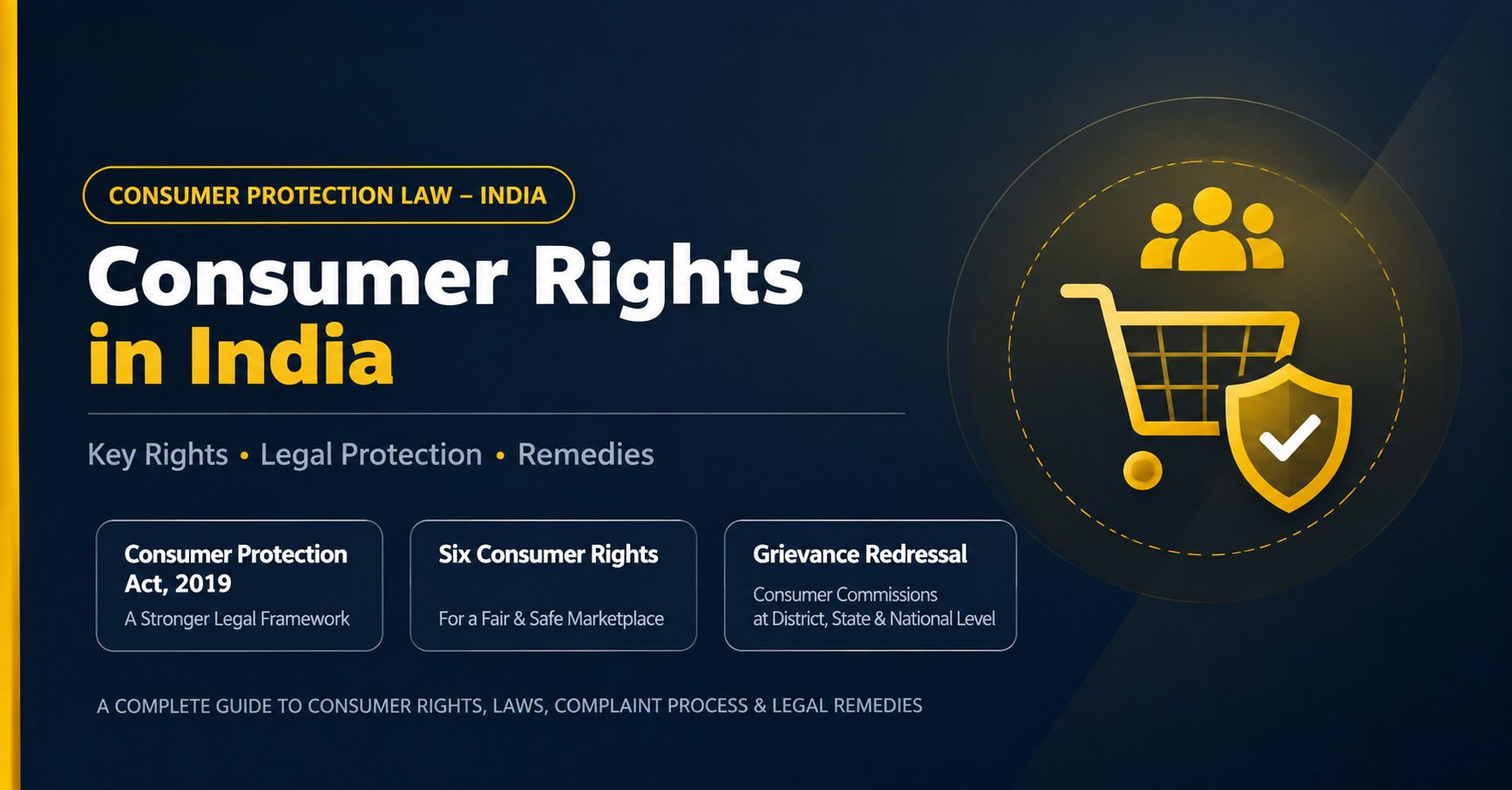
Consumer rights in India are the legal protections given to anyone who buys goods or uses services. The Consumer Protection Act, 2019 sets out six main rights. They cover safety, information, choice, being heard, redressal and consumer education. This guide explains who a consumer is, what each right means, and which laws protect consumer rights in India. It also covers the remedies, the commissions you can approach and the steps to enforce your rights.
Who Is a Consumer Under Indian Law?
Only a consumer can claim the protection of the Consumer Protection Act. So it is important to know who counts as one.
Definition of a Consumer (Section 2(7))
A consumer is a person who buys goods or hires services for a price. The price may be paid, promised or partly paid. The definition also covers a person who uses the goods or services with the buyer's approval. It includes online purchases as well as offline ones.
Who Is Not a Consumer
A person who buys goods for resale or for a commercial purpose is generally not a consumer. The same applies to a person who gets a service free of charge. A person who hires services under a contract of service, such as an employee, is also outside the definition. However, buying goods for earning a livelihood by self-employment is treated differently. Please check the facts of each case.
Consumer Rights in India at a Glance
The table gives a quick view of the six rights. Each is explained in the next section.
| Right | What it means | Simple example |
|---|---|---|
| Right to Safety | Protection from goods and services that harm life or property | A defective pressure cooker that can burst |
| Right to Information | Facts about quality, quantity, price and standard | MRP and expiry date printed on a pack |
| Right to Choose | Access to a variety of goods at fair prices | No forced bundling of unrelated products |
| Right to Be Heard | Your complaint gets a fair hearing | A hearing before a Consumer Commission |
| Right to Seek Redressal | Relief against unfair practices | Refund or replacement for a faulty phone |
| Right to Consumer Education | Awareness of rights and remedies | Government awareness campaigns |
The Six Consumer Rights Under the Consumer Protection Act, 2019
Section 2(9) of the Act lists the consumer rights. The sections below explain each right in simple words.
1. Right to Safety
You have the right to be protected from goods and services that are dangerous to life and property. For example, a faulty electrical appliance or unsafe food can cause serious harm. Manufacturers and sellers must therefore follow safety standards. If a product harms you, the Act allows you to claim compensation.
2. Right to Information
You have the right to know the quality, quantity, purity, potency, standard and price of what you buy. Sellers must not mislead you with false labels or advertisements. Packaged goods, for instance, must show details such as the maximum retail price. This right helps you make an informed choice.
3. Right to Choose
You have the right to choose from a variety of goods and services at competitive prices. The law does not allow unfair limits on this choice. As an example, a seller cannot force you to buy one product only to get another. This right protects you from monopoly and unfair trade practices.
4. Right to Be Heard
You have the right to have your interests considered by the proper bodies. This means you can raise a grievance and expect a fair hearing. You can do this before a Consumer Commission, a regulator or the seller's own grievance cell. Consumer groups can also represent consumers.
5. Right to Seek Redressal
You have the right to relief against unfair trade practices and unfair contracts. The relief can be a refund, replacement, repair or compensation. Consumer Commissions at the district, State and national levels provide this remedy. The section on remedies below gives the details.
6. Right to Consumer Education
You have the right to know your rights and the remedies you can use. The government and consumer organisations run awareness programmes for this purpose. In addition, our own guides on legal awareness aim to explain the law in simple words.
Laws That Protect Consumer Rights in India
The Consumer Protection Act, 2019 is the main law on consumer rights in India. Other laws and rules support it. The table lists the key ones.
| Law | What it covers |
|---|---|
| Consumer Protection Act, 2019 | Consumer rights, Consumer Commissions, product liability and unfair trade practices |
| Consumer Protection (E-Commerce) Rules, 2020 | Duties of online sellers and marketplaces |
| Legal Metrology Act, 2009 | Weights, measures and labelling of packaged goods |
| Sector regulators | Banking, insurance, telecom and food each have their own regulators and complaint systems |
Constitutional values also support these rights. For instance, Article 21 has been read to include the right to health and a dignified life. You can read more in our guide to fundamental rights in India.
Key Changes Under the Consumer Protection Act, 2019
The 2019 Act replaced the Consumer Protection Act, 1986. It brought several important changes.
Central Consumer Protection Authority (CCPA)
This body can act against unfair trade practices and false advertisements.
Product liability
A manufacturer, seller or service provider can be liable for harm from a defective product or deficient service.
E-commerce coverage
The Act applies to online and teleshopping transactions.
Unfair contracts
State and National Commissions can declare unfair contract terms void.
Mediation
Commissions can refer cases to mediation if both sides agree.
Online filing
A consumer can file a complaint online, and need not travel to the Commission.
These changes make it easier for a consumer to seek relief. The Act came into force in 2020. Rules followed in 2020 and 2021.
Defective Goods, Deficient Services and Unfair Trade Practices
Many consumer complaints fall under one of three heads. The Act defines each one.
Defect and Deficiency
A defect is a fault in the quality, quantity, purity or standard of goods. A deficiency is a fault or shortfall in the way a service is performed. For example, a phone that stops working within weeks has a defect. Similarly, a delayed bank refund can be a deficiency in service.
Unfair Trade Practices and Misleading Advertisements
An unfair trade practice includes false claims about goods or services. It also covers misleading advertisements and the sale of goods that do not meet required standards. The CCPA can order a business to stop such practices. It can also order a recall of goods and impose penalties.
Product Liability
Product liability means that a business is responsible when its product or service harms a consumer. The claim can be against the manufacturer, the product seller or the service provider. The Act sets out the conditions for each. A claimant must show that the product or service caused the harm.
Remedies Available to a Consumer
A Consumer Commission can pass orders in your favour if it finds a defect, deficiency or unfair practice. The usual remedies are listed below.
Refund
The Commission can order the price paid to be returned.
Replacement
The faulty goods can be replaced with new goods.
Repair
The defect can be removed.
Compensation
You can receive money for loss, injury or mental harassment.
Stopping the practice
The business can be told to stop an unfair or restrictive practice.
Punitive damages
In serious cases, the Commission can award extra damages.
Costs
The Commission can also order the other side to pay the costs of the case.
The exact relief depends on the facts. No result can be guaranteed. Our practice page on consumer protection law gives a short overview.
Which Consumer Commission Can You Approach?
India has a three-tier system. The Commission you approach depends on the value of the goods or services paid for. Under the Consumer Protection Rules, 2021, the limits are as follows.
| Commission | Value of goods or services paid | Appeal goes to |
|---|---|---|
| District Commission | Up to Rs 50 lakh | State Commission |
| State Commission | Above Rs 50 lakh, up to Rs 2 crore | National Commission (NCDRC) |
| National Commission | Above Rs 2 crore | Supreme Court |
The limits depend on the price you paid, not on the compensation you claim. The Supreme Court took this view in April 2025. A complaint is generally to be filed within two years from the date the cause of action arose.
Appeals Up to the Supreme Court
A party who loses before a Commission can usually appeal to the next level. An order of the District Commission goes to the State Commission. A State Commission order goes to the National Commission. Finally, an appeal from the National Commission lies to the Supreme Court. Each step has a short time limit.
How to Enforce Your Consumer Rights: Step by Step
You can follow these steps in most cases. Keep the bill, warranty card, messages and photographs safe.
1. Raise the issue
Write to the seller or service provider and keep a copy.
2. Call the helpline
Dial 1800-11-4000 or 1915 between 8 AM and 8 PM, except on national holidays.
3. Try mediation or a settlement
Many disputes end at this stage.
4. File a complaint
Use the e-Daakhil portal, or file in person before the right Commission.
5. Attend the hearing
Present your documents. A lawyer is not compulsory.
The helpline also accepts complaints through its web portal, mobile app, UMANG, WhatsApp and SMS. For the filing process in detail, see our page on consumer protection law. If cost is a concern, read about free legal aid.
Consumer Rights in Common Situations
Consumer rights in India apply in everyday life. The examples below show how.
Online Shopping
The E-Commerce Rules require sellers and platforms to show clear details of the goods, price and return policy. You can complain if you receive a wrong or fake product. Platforms must also appoint a grievance officer.
Banking and Insurance
Banking and insurance services are covered by the Act in many cases. A wrongful charge or a rejected claim without reason may be a deficiency in service. Sector regulators also run complaint systems, so you may have more than one route.
Healthcare
Paid medical services can be covered. Negligence or overcharging may lead to a complaint. Free services are generally outside the Act, but the facts of each case matter.
Real Estate
Delays in handing over a flat and defects in construction are common disputes. Buyers may approach a Consumer Commission or the real estate regulator. The choice depends on the facts and the relief wanted.
Recent Developments in Consumer Rights in India (2026)
One recent development in consumer rights in India concerns the Commissions' limits. The Supreme Court is examining how they work in practice. On 13 August 2026, in Avon Elastomers (India) v. Bajaj Allianz General Insurance Co. Ltd., a two-judge bench asked the Centre to respond. The Court gave examples. These included bank fixed deposits and subsidised hospital services, where little or no separate fee is paid.
The Court also asked the Centre to explain the December 2021 cut in the National Commission's limit, from Rs 10 crore to Rs 2 crore.
In April 2025, the Supreme Court had upheld the limits in Sections 34, 47 and 58 of the Act. It held that jurisdiction depends on the consideration paid. Until the Court says otherwise, this rule applies.
Frequently Asked Questions About Consumer Rights in India
What Are the Six Consumer Rights in India?
They are the rights to safety, information, choice, being heard, redressal and consumer education.
Who Is a Consumer Under the Consumer Protection Act?
A person who buys goods or hires services for a price, mainly for personal use. Commercial buyers and free services are generally outside the definition.
Where Do I File a Consumer Complaint?
File it before the District, State or National Commission, depending on the value paid. You can also file online on the e-Daakhil portal.
Do I Need a Lawyer for a Consumer Complaint?
No, a lawyer is not compulsory. You can present your own case. Still, you may take legal advice if the case is complex.
What Is the Time Limit for Filing a Complaint?
It is generally two years from the date the cause of action arose. A Commission can excuse a delay for good reasons.
What Is the National Consumer Helpline Number?
The toll-free numbers are 1800-11-4000 and 1915. The helpline works daily from 8 AM to 8 PM, except national holidays.
Conclusion and Consultation
Consumer rights in India give every buyer a way to seek a fair deal. The Consumer Protection Act, 2019 protects safety, information, choice, hearing, redressal and education. Commissions at three levels can order refunds, replacement and compensation. Keep your records, act within the time limit and use the helpline or e-Daakhil.
For general information, you may read our consumer protection law page or use the contact page of Prashant Shukla Law Chambers.
Disclaimer: This article is for general information only. It is not legal advice and does not create a lawyer-client relationship. It is not an advertisement or solicitation.