Indian Judiciary System: Structure, Hierarchy and Functions
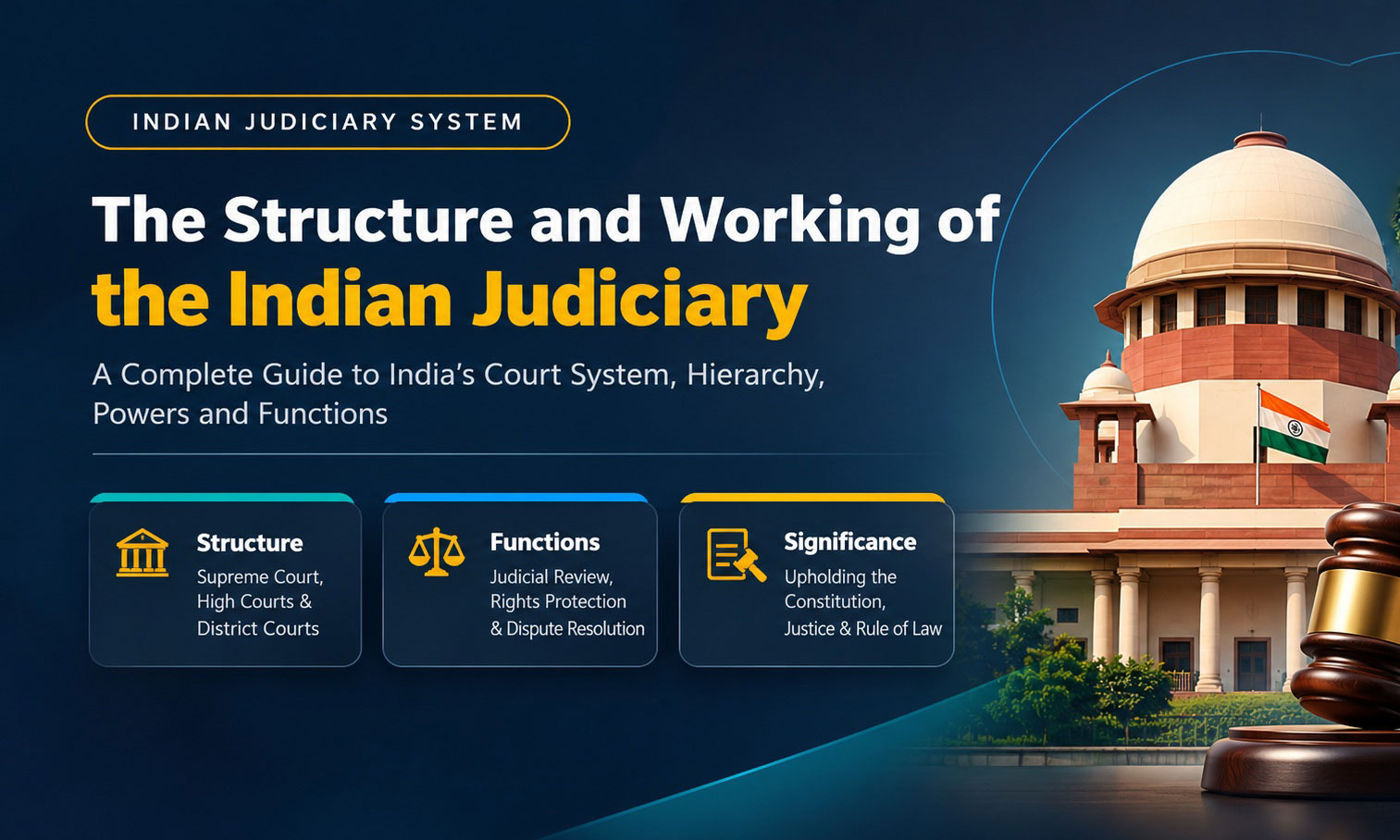
The Indian judiciary system is one connected system of courts. It settles disputes, protects rights and checks how power is used. The Supreme Court sits at the top. High Courts work at the State level, and district courts handle most cases at the local level. This guide explains the structure, hierarchy and functions of the Indian judiciary system in simple words. It also covers judicial independence, key challenges, the e-Courts project and legal aid.
What Is the Indian Judiciary System?
The Indian judiciary system is the set of courts that apply and interpret the law in India. It is a single, unified system. This means one chain of courts decides cases under both Union and State laws. The United States, by contrast, runs separate federal and State court systems.
The Constitution of India creates this system. Part V deals with the Supreme Court. Part VI deals with the High Courts and the subordinate courts. In addition, Article 50 directs the State to separate the judiciary from the executive.
Courts hear civil, criminal and constitutional matters. Tribunals and special forums, such as family courts and consumer commissions, work alongside them. Together, they form the justice system that people meet in daily life.
Structure and Hierarchy of the Indian Judiciary
The courts follow a pyramid. At the top is the Supreme Court, and each lower level answers to the level above it. Here is a quick view of the hierarchy.
| Level | Court | Headed by | Main role |
|---|---|---|---|
| Apex | Supreme Court of India | Chief Justice of India | Final appeals, constitutional questions and fundamental rights |
| State | 25 High Courts | Chief Justice of the High Court | Appeals from district courts, writs and supervision of lower courts |
| District | District and Sessions Courts | District Judge or Sessions Judge | Civil and criminal trials and appeals from lower courts |
| Subordinate | Civil Judges and Magistrates | Civil Judge or Judicial Magistrate | Trials of lower-value civil cases and less serious crimes |
| Village | Gram Nyayalayas | Nyayadhikari | Small civil and criminal cases near the village |
Appeals normally move upward through this ladder. The sections below explain each level.
Levels of Courts
Supreme Court of India
The Supreme Court is the highest court in the country. Article 124 of the Constitution establishes it, and it sits in New Delhi. Its sanctioned strength is now 38 judges, including the Chief Justice of India. The Court hears appeals from High Courts and tribunals. It also decides disputes between governments and protects fundamental rights. Under Article 141, the law it declares binds all courts in India. Read our detailed guide on the Supreme Court of India.
High Courts in India
Article 214 provides a High Court for each State. India now has 25 High Courts. Some serve more than one State or Union Territory. For example, the Punjab and Haryana High Court also covers Chandigarh. The Bombay High Court covers Maharashtra, Goa, and Dadra and Nagar Haveli and Daman and Diu. The Calcutta, Bombay and Madras High Courts are the oldest. They were set up in 1862 under the Indian High Courts Act, 1861. The Andhra Pradesh and Telangana High Courts are the newest. Both began on 1 January 2019. The Delhi High Court was established on 31 October 1966, and its seat is in New Delhi. High Courts hear appeals from district courts. They can also issue writs under Article 226 to protect rights and enforce legal duties. In addition, they supervise the lower courts under Articles 227 and 235.
District and Subordinate Courts
District courts are the first point of contact for most people. Under Article 233, the Governor appoints district judges in consultation with the High Court. The High Court then controls the subordinate judiciary. The District Judge heads the district judiciary. On the civil side, the District Judge hears major civil cases and appeals. Civil Judges (Senior Division and Junior Division) handle cases below that level. On the criminal side, the Sessions Judge tries serious offences. The Chief Judicial Magistrate and Judicial Magistrates try less serious ones. In large cities, Metropolitan Magistrates do this work. Criminal courts now follow the Bharatiya Nagarik Suraksha Sanhita, 2023 (BNSS). It replaced the Code of Criminal Procedure and came into force on 1 July 2024. In Delhi, district courts sit in several complexes. Examples are Tis Hazari, Patiala House, Saket and Karkardooma.
Gram Nyayalayas (Village Courts)
Gram Nyayalayas are village-level courts. Parliament created them through the Gram Nyayalayas Act, 2008. Their aim is to bring justice to the doorstep of rural people at low cost. A Nyayadhikari presides over each Gram Nyayalaya. These courts hear small civil and criminal cases. They use simple procedures and try to settle disputes through conciliation first. The scheme has grown slowly. On 20 December 2024, the Law Ministry told the Lok Sabha that States had notified 488 Gram Nyayalayas. Only 313 were functional, in 11 States. Please check the latest figure on the Department of Justice website.
Main Functions of the Indian Judiciary
The judiciary does much more than decide individual cases. Its main functions are listed below.
Settling disputes
Courts resolve civil, criminal and family disputes between people, and between people and the State.
Interpreting laws
Courts explain what a law means when its words are unclear.
Judicial review
Courts can strike down a law or an action that goes against the Constitution.
Protecting fundamental rights
A person can approach the Supreme Court under Article 32 or a High Court under Article 226.
Checking the executive
Courts ensure that government bodies act within the law.
Settling federal disputes
The Supreme Court decides disputes between the Union and the States.
Supervising lower courts
High Courts guide and control the courts below them.
Declaring binding law
Higher courts set precedents that lower courts must follow.
Public interest litigation also lets people approach the courts for social causes. Read more in our guide on fundamental rights and PIL.
How Does the Indian Judiciary System Work?
A case starts at the lowest court that has jurisdiction. Civil and criminal cases follow different paths. Civil cases follow the Code of Civil Procedure, 1908. Criminal cases now follow the BNSS, the Bharatiya Nyaya Sanhita, 2023 and the Bharatiya Sakshya Adhiniyam, 2023. Most cases move through the following steps.
1. Filing
A plaint, complaint, FIR-based charge sheet or petition starts the case.
2. Scrutiny
The court registry checks the papers and gives the case a number.
3. Notice
The court sends a summons or notice to the other side.
4. Hearing
Both sides present arguments and evidence.
5. Judgment
The judge gives a reasoned decision.
6. Appeal
A party who disagrees can appeal to a higher court.
The usual route of appeal runs from the district court to the High Court. After that, a party may approach the Supreme Court. Many appeals reach the Supreme Court through a Special Leave Petition under Article 136. Read our related guide on Special Leave Petitions.
Independence of the Indian Judiciary
An independent judiciary can decide cases without pressure from the government or anyone else. The Constitution protects this independence in several ways.
Security of tenure
A Supreme Court judge can be removed only by Parliament, through the process in Article 124(4).
Fixed pay
Judges' salaries are charged to the Consolidated Fund, so they do not depend on yearly votes.
Limits on debate
Article 121 restricts Parliament from discussing the conduct of judges in discharging their duties.
Separation of powers
Article 50 directs the State to separate the judiciary from the executive.
Contempt powers
Articles 129 and 215 let the higher courts punish contempt of themselves.
Appointments also matter. Judges of the higher courts are appointed through the collegium system, which grew out of Supreme Court judgments. In 2015, the Supreme Court struck down the National Judicial Appointments Commission Act.
E-Courts Mission Mode Project in India
The e-Courts Mission Mode Project is a national plan to bring technology into courts. It is run under the e-Committee of the Supreme Court and the Department of Justice. Its goal is to make justice easier to reach and faster to deliver. Phase III was approved in 2023 for the period 2023 to 2027, with an outlay of Rs 7,210 crore. It aims at digital and paperless courts, e-filing, virtual courts and better data systems. The Press Information Bureau reported these figures on 7 August 2026.
cases e-filed up to 30 June 2026
hearings held by video conferencing
challans received by 31 virtual traffic courts
pages of court records digitised
Citizens can use the eCourts Services portal and the NJDG to check cases and data. Both are free to use.
Legal Aid and Access to Justice in India
Access to justice means that every person can reach a court, whatever their means. Article 39A of the Constitution directs the State to provide free legal aid. Parliament passed the Legal Services Authorities Act, 1987 to give effect to this.
The Act created a network of authorities. The National Legal Services Authority (NALSA) works at the national level. State and District Legal Services Authorities work below it. Together, they provide free lawyers, advice and Lok Adalats.
Certain groups qualify for free legal aid. These include women, children, persons in custody, members of Scheduled Castes and Scheduled Tribes, and persons with disabilities. Others qualify if their income is below the limit set by the State.
Lok Adalats settle disputes by mutual agreement. They do not charge court fees. Read more in our guides on free legal aid in India and how to apply for free legal aid in Delhi.
Frequently Asked Questions About the Indian Judiciary System
Which Is the Highest Court in India?
The Supreme Court of India is the highest court. It sits in New Delhi, and its judgments bind all other courts.
How Many High Courts Are There in India?
India has 25 High Courts. Some of them also serve more than one State or Union Territory.
What Is the Role of District Courts?
District courts hear most civil and criminal trials at the local level. They also hear appeals from the lower courts in the district.
What Are Gram Nyayalayas?
Gram Nyayalayas are village courts set up under the Gram Nyayalayas Act, 2008. They hear small civil and criminal cases near the village.
What Is the e-Courts Mission Mode Project?
It is a national project that brings technology into courts. It covers e-filing, video hearings, digital records and online case information.
How Can I Check My Court Case Status Online?
Visit the eCourts Services portal and choose Case Status. Select the State, district and court complex. Then search by CNR number, case number or party name. For the Supreme Court, use the case status page on sci.gov.in.
Conclusion: Understanding the Indian Judiciary System
The Indian judiciary system is a single chain of courts, from Gram Nyayalayas to the Supreme Court. It settles disputes, protects rights and keeps power within the Constitution. Its main challenges are pending cases and vacancies. At the same time, e-Courts and legal aid are making justice easier to reach.
To see the areas of law the Chambers handles, read about its practice areas. For general information on procedure, you may also use the contact page of Prashant Shukla Law Chambers.
Disclaimer: This article is for general information only. It is not legal advice and does not create a lawyer-client relationship. It is not an advertisement or solicitation.